This is the last sugar cane mill on Maui, which closed about a year ago. Sugar cane was once the most important crop on Maui. Polynesian settlers introduced sugar cane to Hawaii more than one thousand years ago but at the time they just chewed the stalks. They started making sugar in 1835 when the first successful plantation was established on the island of Kauai. I passed this plant on two occasions - coming from the airport and going to the airport four days later. I could have spent half the day here photographing this abandoned plant! Instead I had to grab a few shots out the window as we drove by. There is a sugar museum across the street from this plant and I would have loved to see that as well. You should know that when the plant was operating, smoke poured from the stacks in the picture. And as part of the process, the sugar cane fields are burned after the harvest, and people hated the smoke from the fires that made some homes unlivable during the burning.
Wednesday, October 4, 2017
Tuesday, October 3, 2017
How to Photograph a Tree
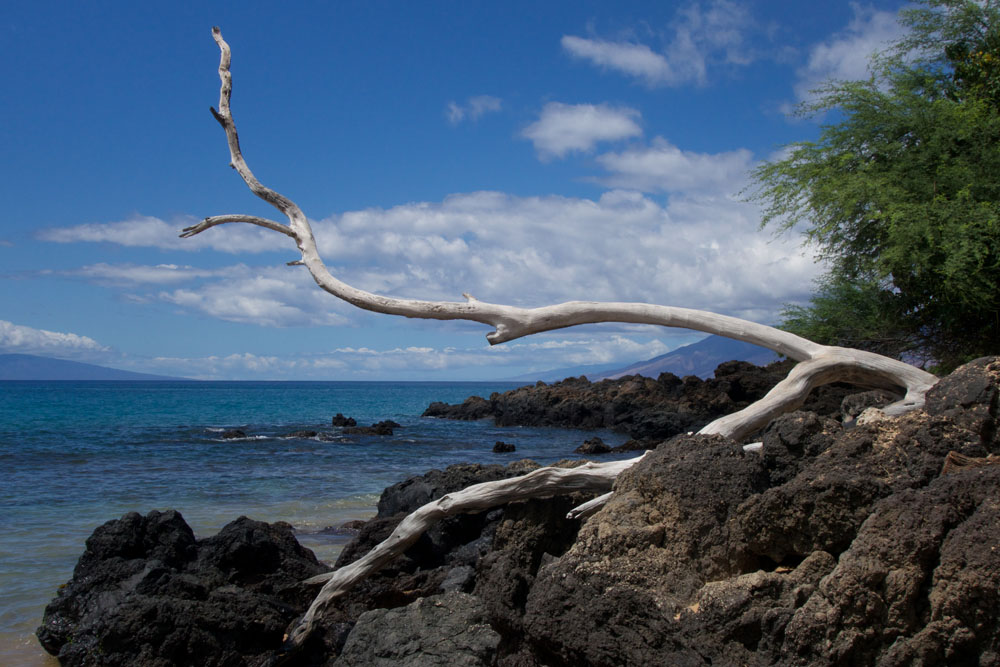
We went to a beautiful beach to do some snorkeling - Amy found that it was listed as one of the best snorkeling beaches in Hawaii. When we arrived at the beach, I immediately noticed this sun bleached silver tree at one end of the beach. I immediately started photographing it as the light changed and I tried different compositions. I started with wide views and then moved in closer. Two days later we came back for more swimming and things were different, so I took even more photographs. So here are four of the variations - you can pick your favorite. And please let me know.
Monday, October 2, 2017
Above The Beach
The ladies were downtown shopping in Honolulu, and I was on my way to hike the trail to the top of Diamondhead. Only it was closed because they were repairing a rockfall on the trail. Earlier I had driven by a lighthouse on a cliff, so I went to try and photograph the lighthouse. What I discovered was that when I stood on the cliff by the lighthouse, I could see a beautiful beach about two hundred feet below.
So I saw some people walking down a trail, and I followed them down to the beach. There were a number of people down there, some sunbathing and some getting ready to surf.
This surfer with his board stood here for perhaps 5 or 10 minutes while he carefully studied the water and the surf, before he put his board in the water and paddled out.
I walked along the beach to try and get closer to the lighthouse, but this was the best view I could get.
And this is a view of the landscape at the bottom of the hill. I love the neutral brown colors and the faint green color in the distance.
Sunday, October 1, 2017
Eats
I have written about and showed you the shrimp truck. So this is everyone eating the shrimp from the truck. See all those smiles? That was some awesome Louisana style spicy shrimp! There are a couple of picnic tables set up near the truck so people can sit and enjoy their meal.
This is everyone, getting ready to eat again! Maybe 20 miles or so after the shrimp, we stopped at a collection of maybe 10 food trucks. That's where I found my wonderful Kona Mocha Latte. Here everyone is quizzing the coffee merchant before ordering their drinks.
Saturday, September 30, 2017
Banzai Pipeline
There were a couple of places I definitely wanted to see while visiting Hawaii and this was one of them. This is Ehukai Beach Park on O'ahu's North Shore, and the location of The Banzai Pipeline, one of the most famous surf reef breaks in the world. This yellow surfboard signals that is the location of one of the lifeguard stations.
A reef break is an area in the ocean where waves start to break once they reach the shallows of a reef. Pipeline is notorious for huge waves which break in shallow water just above a sharp and cavernous reef, forming large, hollow, thick curls of water that surfers can tube ride. Waves reach heights of 9 to 12 feet and above, and people come here from all over the world to surf these monsters. This is the actual beach which is the location of the Banzai Pipeline. Guess what? There were no ocean swells, so the water was flat as a pancake. The big waves usually form starting in November and on through winter. Here is a link to a YouTube video of Banzai Pipeline and surfers: https://www.youtube.com/watch?v=m0Z4vSrF8dc
We stopped to talk to a couple of lifeguards on the beaches, and they were so friendly and happy to explain some of the stories of this famous beach and of the history of surfing, and of the Pipeline. This is Johnny, who has lived here all his life. He is the son of a famous father who was a surfer and diver. Talking to people like Johnny made the trip such a rich experience.
Friday, September 29, 2017
Food Trucks
We did a lot of eating at food trucks alongside the roads we were traveling on. We ate some awesome food from these places! The Shrimp Shack had some killer shrimp with a spicy sauce, and this vendor has won prizes from both the Food Network, and Best Restaurants in Hawaii.
We stumbled across a field filled with perhaps 10 trucks of vendors of different kinds of food, coffee, and clothing.
I had an amazing Iced Kona Mocha Latte that was out of this world, from this truck. It was fun spending time talking to the owner, who was a businessman in some other state before moving to Hawaii and buying this coffee truck.
This vendor was not open, but they had a great display, with the bright yellow surfboard which matches the yellow school bus.
Thursday, September 28, 2017
Starting Over
I have taken so many photographs on this trip, that there was no way I could post the photographs as fast as I took them. So I am starting over, and posting images from the trip, starting at the beginning. This is the Arizona Memorial, in honor of the USS Arizona which was sunk by a Japanese bomb on December 7, 1941. The bomb set off the power magazine, and the ship exploded suddenly. It happened so quickly and the explosion was so powerful that the ship sank suddenly, and 1,177 Officers and crewmen died. Many are still entombed in the hull.
So these are photographs of the outside and the inside of the memorial, which was constructed so that it spanned the sunken hull, without touching it.
This wall has inscribed on it the names of all those lost in the attack.
This is one of the supports for a huge gun turret on the ship, mounted on one of the decks of the battleship. There were four of these turrets mounted on the ship. After the sinking, parts of the Arizona were saved to use on other ships, and the gun turret with three huge guns was removed from this mount.
There is an opening in the floor of the memorial structure spanning the ship, and it gives a view of the hull. Depending on the sea condition, sometimes you can see the sunken hull more easily.
It was a very sober and moving experience to visit the ship and the memorial.
Subscribe to:
Posts (Atom)